Sunday, March 28, 2010

The Week of March 22nd

If i went back in time I would help myself with power. Power has units of joules per second. It is measure in watts. To find power you divide work by time. Now we are able to be given facts and we can find power, work, and acceleration using a series scientific equations. The equations could look like mass times acceleration equals force, force times change in position equals work, and work divided by time equals power.

We learned this using the energy activities online. It gave us many problems and examples. It also explains equations and other things involving energy. Besides this we learned doing games and examples on the board with our class. We discussed in groups to further our understanding and worked in partners. We also had a couple quizes that we took with our table, which helped us get better grades on it.


This information will help us in the future because in a week we will be having a test on it and if I don't understand it I wont do well. Also when we learn a new subject I am sure this will come into play as we do new problems and activities.
There was no specific experiment we did on power. We mostly did situations and figured out power using different equations.

Sunday, March 7, 2010

The Week Of March 1


Dear past self,

When you begin to do the unit of Energy you need to know how to decided what objects that are in a specific system. At first I wasnt very good at indentifying systems. Now it is easier for me because I know the following things:


1. A system is a group of things that work together to do a task. Therefore if there is an object that doesnt affect or take part in the system it isnt part of it.


2. Anything could be part of a system, not just the obvious things. For example if you are jumping on a trampoline the force of the earth pulling you down could be part of the system.


3. A System can not do work on itself, so there will always be an outside force that starts the system. This means when your are deciding what should be in the system do not incude the outside force.


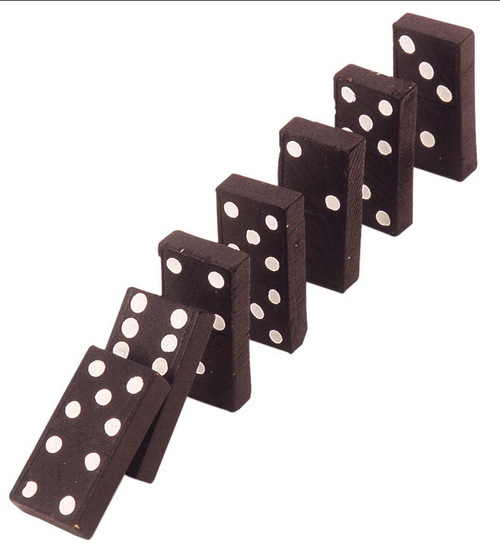
Experiment- A helpful experiment that we did in class was about 6 students stood in a line with there arms locked out in front of them. Mr. Finley was behind us and he pushed us making the person at the end fall forward. In this experiment the students are the system and Mr. Finley is the outside force.
The picture is a representation of the experiment above. The dominoes are a system.

Sunday, February 7, 2010

The Week of February 1st


Dear past self, I would like to tell you all about the characteristics of the moon. This will really help you understand more about astronomy. First there are many lunar surfaces, but I am going to focus on three. The first one is the crater. A crater is simply a hole, varying in lengths and depths, in the moon. It is created as a result of an asteroid/meteor impact. Also, another lunar surface is the ray. A ray is ejections, spray, and debris jetisoned away from a crater. Finally, I'd like to explain rilles to you. Rilles are folds on the surface created from collapsed underground lava flows. You should know these concepts. It will help you.


Experiment- A good experiment is to drop a marble into a pie tin of flower. It simulates an astroid hitting the moon, because the moon is very dusty and powdery. After you drop the marble you can observe the depth of the crater and the length of the rays.

Thursday, January 28, 2010

The Week of January 18(absent)

This week we learned about the different types of tides and continued our work on seasons. We concluded that there are seasons because the earth has a constant tilt and when the sunlight is more focused on part of the earth it will be hotter.There are neap tides, high tides, low tides, and spring tides. Also I learned that a solstice is when the earth's tilt is away or towards the sun. An equinox is when the earth's tilt is right in the middle.

We learned this using many simulations. One of them was a virtual orbital situation. We also used the simulation to write a lab that concluded our knowlege in the subject. We also were verbally taught by Mr. Finley.

These ideas are important to know because later in the marking period we will be having a test. Also astronomy is good to know in every day life. Such as going to the beach or planning an event. These ideas are actually more important than you think.

Monday, January 18, 2010

The Week of January 11

This week we continued our study of astronomy. We learned about how the force of the earth on the moon affects the oceans tides and how there are spring tides ,high tides, and low tides. We focused on why there are seasons, thoughout the week. There are seasons because the earth has a constant tilit so at certain times the sunlight can be more focused or not. We also had a biology placement test.

We learned these science ideas in many different ways. We used another simulation that showed us the seasons. We also used the smartboard and a machine that detects how focused light is. We tested this machine with a flashlight pointed at different angles and lengths from it. This helped us understand why it is hotter when the sun is farther away from the earth. These ways helped me greatly.

These science ideas are important because last week we learned about the moon and the sun and now we are furthering our learning towards how they make seasons. This will continuely help us keep learning until we know alot about the subject. Without these science ideas we wouldnt be able to keep learning this subject so we wouldnt get far at all. In conclusion we learned many science ideas this week.

Sunday, January 10, 2010

The Week of January 4th

This week we started working on astronomy. This is the study of the moon and stars. We also learned the difference between Revolution and Rotation. Revolution is when something travels around a fixed point. Roation is when something travels on a fixed point. We learned about the moon phases such as the new moon, waning gibbous and crescent, full moon, and waxing gibbous and crescent. We also learned how the force of the earth on the moon affects the tides.

We learned these ideas in many ways. One way was through Mr. Finley teaching us all of these ideas. We also learned through a helpful moon simulation lab on the computer. It had many different parts to it that really helped me understand it. The final way we learned this was through a pneumonic phrase about the many moon phases.

These science ideas are important to us because we will have to understand these ideas to do well on tests in the future. Also this specific subject could allow us to look at the moon the night before you go to the beach and be able to know how high the tides will be. Science ideas such as these always can help people in the future.

Sunday, December 20, 2009

The Week of December 14

This week we did alot of reviewing for the upcoming test, but we also learned some new science ideas. We learned about friction and air resistance and how it affects scientific learning. We continued on our force diagrams and made more number sentences. We also learned about Newton's third law and to draw a force diagram for it you need two seperate ones to show each vantage points. These new science ideas will help me on the test.


I learned these ideas by taking notes and doing homework. I also completed a 5 page extra credit study guide that helped me. Not to mention that i completed many review questions for the test. We also had many examples and demonstrations. This week we even wrote a small story about friction to help our knowledge. Without these ways I wouldn't fully understand the science ideas.


These ideas are important because they will help me on the test. Also it will prepare me for more scientific things in the future. It also helped me furthermore my knowledge on the the last and the present unit that we are enduring. These science ideas are important because it will help me in the future, not just the present.

Sunday, December 13, 2009

The Week of December 7

This week we learned many more science ideas. We learned more things about force diagrams. We now don't just put vertical arrows we put horizontal arrows to show if the object is moving or being pushed. For this you have to make two number sentences representing both displays of motion. The most important thing we learned this week is that delta v arrows are always in the same direction as the unbalanced force. Of course one is on a force diagram and one is on a motion diagram. This was a breakthrough which helped us understand most of the work to follow it.

This week we learned information in many different ways. Like always we took notes and followed examples and experiment. But, this week we learned information in many more different ways. My favorite way was in the form of a debate. Our class chose sides on a science idea and we argued our idea until one side figured out they were wrong by our information and examples. I found this a fun way to learn.

These science ideas are important to know, because when we have tests or quizzes this following week we will need to know this or we wont get a good grade. Also later in the year, when we go on to different subjects we might have to go back to this to furthermore our learning in that specific subject. These are two good reason why this is important.

Sunday, December 6, 2009

The Week of November 30th

After our science test this week, we learned many key ideas about motion. We learned why motion moves and how to draw a force diagram. We also learned that gravity is not an object and to express it we should use the word earth. So when you put a book on the table, the book pushes down and the table pushes up at the same force making the book rest on the table. If there was more negative force the book would fall down, and if there was more postive force the book would go up. We also learned how to write equations for these objects. For my previous example it would be 5n +-5n=0n, making the position equal. Of course n stands for newtons. I also had to guess the amount of newtons.

We learned this by many ways. We were taught vocally, by Mr. Segen and we wrote down good notes. Although this was key in my increase in knowledge, the most important way we learned this was through models and diagrams. We used bowling balls, small weights, and even ourselves to model motion for our learning. One day we even got to push a car, so we could represent the motion of how the car was moving in mid-push and after we stopped. This was how we learned the science ideas.


This is important to know because although we already learned alot about motion, but to fully understand motion and to become a scientist you always must keep researching further, because there is always something to learn in the world of science. Also if we learn about different science ideas and there is a problem or situation that need what we already learned we can process it easier using the fundamentals of motion. These are really important reasons why we should know this

Sunday, November 22, 2009

Week of November 16

This week I learned many key science ideas. We learned more about motion. We applied graphs and pictures to figure out experiments including colliding cars. We also learned about displacement, or the distance from the starting and end point. Most important, we learned how to make a horizontal and vertical motion diagrams. This is just like a dot diagram but it has the directions, the origin, velocity arrows, and delta V arrows. A delta V arrow is the change in velocity. If it gets faster the delta V arrow points in the same direction as it originially was going in. If it gets slower the delta V arrow points in the opposite direction

We learned these ideas many ways. One way was Mr. Segen carefully went over it with us to make sure we grasped the concept of this. We also learned this, by experiments, notes, and pictures we drew that we based on this week's learning. Also quizes are a great way to learn and review earlier learned information. Most importantly, we learned with the help of our science squad group. They helped me grasp the concept when i didn't understand.

It is very important to know this because as a scientist you must have a basic understanding of all of the topics. Even after going to anopther topic things may relate back to this. Which is a great reason why it is important to know this. Finally, as cheesy as it sounds it is a great conversation peice. It seriously makes you look smarter and in the process of it you may inspire a person that you are talking to.

Sunday, November 8, 2009

The Week of November 2nd ( short Week so not as much writing)

This week not much was done due to a short week. Although our usual work load was lessened we did learn some pretty important things including slope and speed. In what we are talking about slope and speed are the same thing. To find the slope you put the vertical change over the horizontal change from a graph and write it as an expression. Also slope is used to describe the measurement of steepness of a straight line. We did some exact examples using scenarios such as super grover's speed which equals in our minds, x(t)=200 m over s. In conclusion that is what we did this week.

The Week of November 2nd ( short

Sunday, November 1, 2009

October 26th, The Week of

This week we learned about motion. We learned that motion is relative which means it can be scene differently from different vantage points. We did many experiments using telescopes,trying to dscribe the motion of different objects. We also used car scenarios where different people are looking at cars moving differently. We connected science to math saying tht motion is like a number line,some movement is negative and some is positive. This depends on what direction something moves in.
We also learned how to make dot diagrams which describes the motion or speed of an object uisng dots and distance to reperesent the amount of seconds it takes for a certain object to move a certain distance. I was also taught how to make a graph using speed and position and curving the line according to how fast or slow and object is going. The last thing we did was mark cars speed and made tables and graphs out of them. We did this with the help of a metronome.

Sunday, October 18, 2009

The Week of October 12th

This week we continued our study on refraction and reflection in preparation for a science test.We made rubrics for ray and wave diagrams so in the future we know how to make them. That is a good reason for why we need to know this in life. Tests are a part of life. To get back to science we also had a science carnival where we went to different stations and observed things. Some stations included a drawing that we had to describe while other stations gave us scenarios that we had to analyze and decide which person in the scenario was right.
This week we also learned about how the eye works. To explain this i would tell you light bounces off an object and goes in every direction including the eye. But the rays that hit the bottom of the object only have room to go into the top of the pupil and the rays from the top of the object only have room to get into the bottom of the pupil. This almost directly compares with the flame turning upisdedown. Anyway once the rays go into your eye they cross eachother therefore displaying the object upsidedown in your eyes. But fortunately the brain flips the image displaying it rightside up.
Finally i learned about the densitys of certain objects. Glass is the most dense object. Water has medium density and air has the least density. When light travels from a less dense to more dense object is bends or refracts towards the normal line, but when it goes from a more dense to a less dense object it bends away from the normal line. In concluison that is what we did this week.

Monday, October 12, 2009

Why its important(continuation of october 5th)

These theories are important because to become a scientist you must know these to compare when you have experiments or observations of light. Also this comes in handy or it is important as a student. On tests and during discussions these theories can become good to elaborate on.

Saturday, October 10, 2009

The Week Of October 5th

This week we learned about light and how it travels through water. First we looked at a ruler submerged in a cup of water. At the point of where the ruler hit the water the ruler seemed to expand in width. My group and I predicted this was because the glass/water magnified the ruler. We then put a ruler in a large, flat basin. It almost looked like the water was making the ruler bend. Later on i learned this was called refraction which means when light bends as it hits water or glass.
We also learned about two seperate hypotheseis about light. Isaac Newton believed that light travels in particles which when was tested soon proved to be wrong. Huygens believed that light travels in waves which is what we are testing currently in class. We believe that when light is about to go in water it is going fast and when light hits the water it refracts and goes slower. Then when its goes past the glass or water it starts to go at a fast speed again in the same angle it was going before it hit the water.

Sunday, October 4, 2009

The Week of Sepetember 27

This week we continued our studies on light and laser pointers. We created an experiment using a laser and a protractor to test if you point a laser at a certain angle will it bounce off in that direct angle. For more information about this experiemnt you could see my lab report that is due on moday Ocotober 5th. Mr. Finley taught us that the angle that you point the laser at is called the laser of incidence and the angle it bounces of of is called the angle of reflection. The angle of incidence is the independent variable and the angle of reflection is the dependent variable.
This week we also learned about light particles or Photon particles. These particles make up light. We also made hypothesis of what happens when light hits off water. Besides that we came up with 5 descriptions of particles. These descriptions include that they are fast, they bounce off objects, they bounce off things congruently, light is made up of them, and they bounce in spread directions when they hit a rough surface. That concludes this weeks blog.

Monday, September 28, 2009

The Week of September 21

This week we extended our researches on light. We learned that a flame is reflected upside down because theres only enough room for the top to go through the bottom part and the bottom to go through the top part of the hole in the cardboard. I also learned how a camera works. The flash of the camera hits the object and bounces back into the lense and it is saved into the hard drive or memory of the camera.
In the second part of the week we examined a laser pointer hitting a mirror and bouncing back onto the wall. We determined that either surfaces have different reflectiveness or that the laser pointer hits off the mirror in a straight direction onto the wall. Our experiments for these hypothesis' include shining the laser light on different objects to see how bright or how big the light is on the surface. That concludes last weeks science classes.

Saturday, September 19, 2009

The Week of the September 14th

This Week in Mr. Finley's class i learned many new ideas about light. I learned these ideas by testing many experiments. One of the biggest experiments about light we had was the dark room experiment. My hypothesis was that in a dark room our eyes would adjust to having no light in 5 minutes. Our experiment was we went under Mr. Finleys desk in the complete darkness. After 5 minutes if you could see what the sign on the wall said your hypothesis would be right. My prediction was after 4 or 5 minutes i would be able to see the sign. When i did my experiment i could see nothing. My conclusion was that you cant see in the dark because when you see, the pupils expand in your eyes to bring in light and without light this cant happpen. It is important to know this idea so if you decide to go somewhere or do something at night you wont hurt yourself. We also learned about light rays,but we are not completely finished with that experiment.
Later in the week we also learned about laser pointers. We learned that a laser pointer flows in a straight beam until it hits a solid object. We are all able to see the dot because the dot hits onto the wall and bounces in many directions into our eyes. This concept is also the same with light rays. To end my post we learned that the laser pointer travels in a straight beam by clapping flour with chalk earsers by the beam showing the beams fullness. This works because flower particles are opaque enough for the beam to bounce off of into our eyes. THE END